

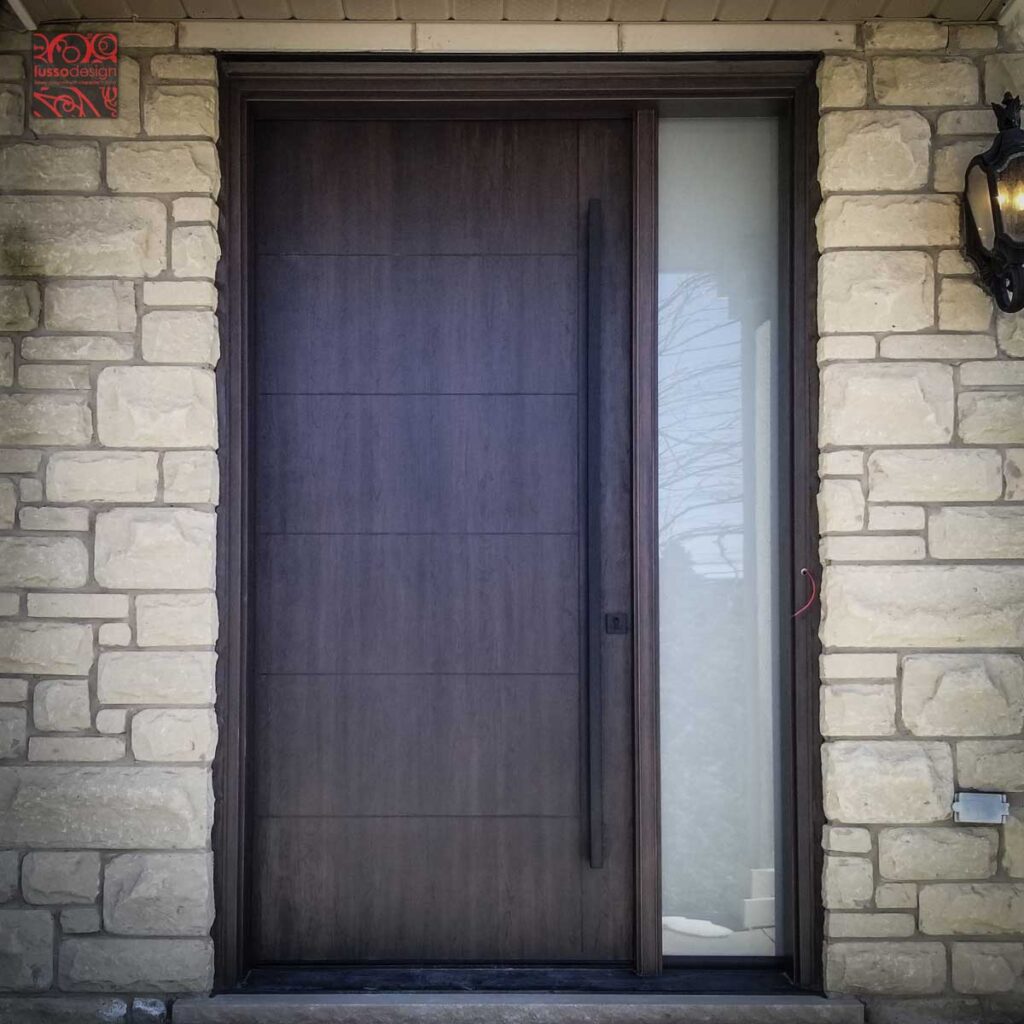
At this point, we’ve done quite a few modern engraved fiberglass doors with pull bar hardware. It’s been one of the biggest trends over the past five years, and for good reason—clean lines, minimal detailing, and bold hardware make for a strong, contemporary look.
But every once in a while, a project comes along that reminds you that even in design, rules are meant to be understood before they’re broken.
This project we completed for Dark Horse Management is a perfect example of that.
The “Standard” Approach
Let’s start with what would normally be expected.
When you have a door that’s stained the same color on both the interior and exterior, the typical approach is to carry that finish through to the casing around the door. It creates a unified, cohesive look and visually separates the door assembly from the surrounding wall.
That’s the safe move.
But in this case, the trim style changed the equation.
A Different Kind of Trim Language
The casing used here is a flat contemporary profile with a single reveal line—a style that works best when it’s not treated as a standalone frame, but rather as part of a larger, continuous system.
Instead of isolating the door with a contrasting casing, this trim was designed to flow directly into the baseboard and continue through the wall paneling (wainscoting).
That gave us two distinct design directions:
- Frame the door
Add a back band to the casing, stain it to match the door, and visually separate the entry from the rest of the wall. - Blend the door into the architecture
Continue the trim profile and color seamlessly through the baseboard and wall, making the door part of a larger composition.
We went with the second option.
The Result: Seamless Integration
By carrying the trim and color through the entire wall system, the door becomes less of a standalone object and more of an integrated architectural feature.
It’s a subtle shift—but it completely changes how the space feels.
Instead of drawing a hard boundary around the door, the design allows the eye to move fluidly across the entire wall. The door still stands out, but in a much more refined, intentional way.
Credit Where It’s Due
I’ll be honest—I usually like to control everything that touches the door, including the trim. Call it attention to detail or just a bit of OCD.
But on this project, the trim carpentry and painting teams absolutely nailed it. The execution was flawless, and it made the entire concept come together exactly the way it was intended.
Final Thoughts
Projects like this are a great reminder that design isn’t just about following rules—it’s about understanding them well enough to know when it makes sense to do something different.
Modern doors are often associated with simplicity, but achieving that “simple” look requires a lot of thought, coordination, and precision behind the scenes.
And when everything aligns—door, trim, finish, and architecture—you end up with something that feels effortless.