

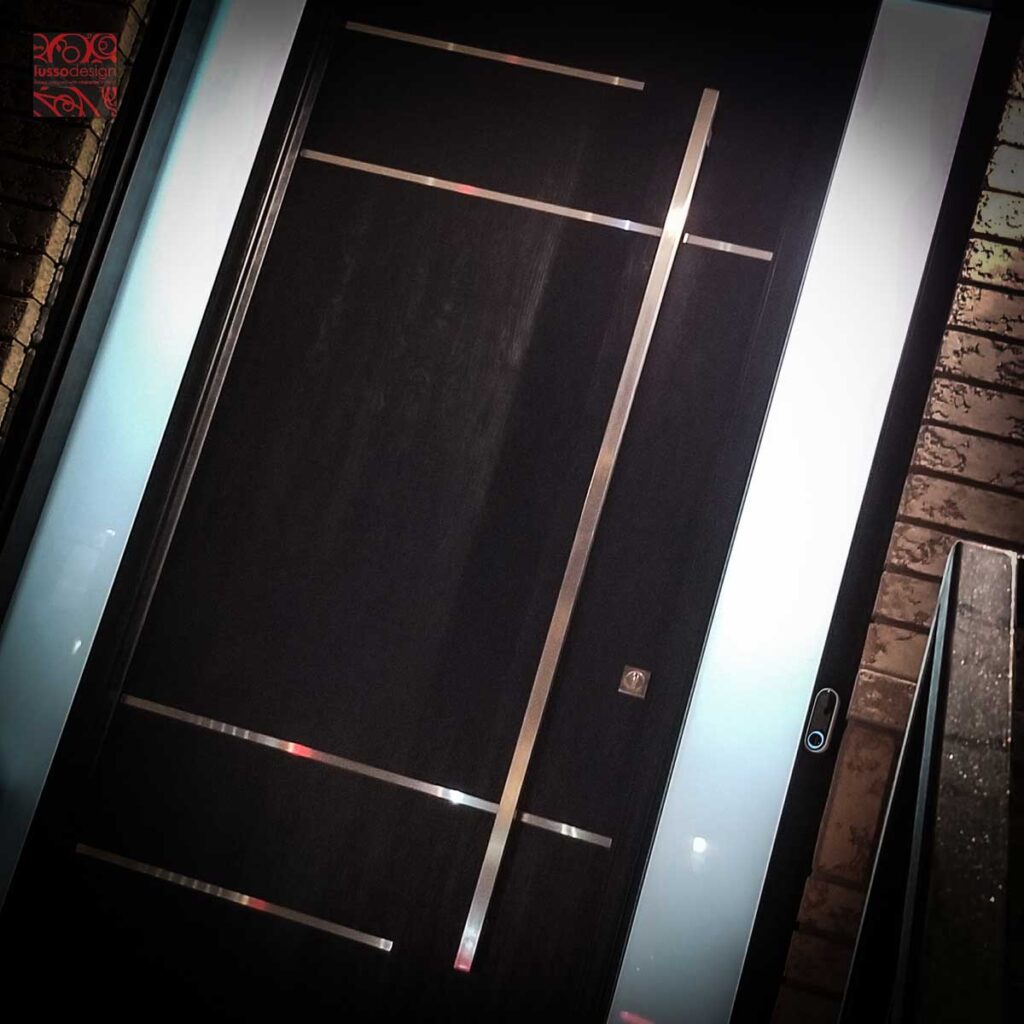
There’s something about stainless steel accents on a black front door that just looks incredible.
The contrast between the dark finish and the reflective metal creates such a clean, sharp appearance. And when the lighting is just right, those stainless steel details really come to life. This particular project is a great example of how a relatively simple design can make a huge statement, especially when the proportions of the door are anything but ordinary.
A Modern Front Door That Fits the Architecture
One thing I always consider when designing a custom entry door is how well the style will work with the rest of the house. A modern black door with stainless steel accents is a fairly bold design choice. It works beautifully with contemporary architecture, but it isn’t necessarily something I’d recommend for every home.
If the surrounding windows, brickwork, trim, and architectural details are more traditional, an ultra-modern door can sometimes look completely out of place.
Fortunately, this particular house was a great fit for the design. The black finish, clean lines, and stainless steel inlays complemented the existing architecture, creating a contemporary entrance without making it feel disconnected from the rest of the exterior.
Replacing Double Doors with a 42-Inch Fiberglass Door
One of the interesting things about this project is that the finished door doesn’t necessarily look as large in photographs as it actually is. Without something beside it for scale, you might assume it’s a fairly standard-sized front door. In reality, this is a massive 42-inch-wide, 8-foot-tall fiberglass door.
Together with two sidelights, the new entry system fills an opening measuring approximately 68 by 95 inches.
Originally, the entrance featured a traditional double door with a small transom window above it—a configuration commonly found in many subdivision homes throughout the Greater Toronto Area. By replacing that setup with a single oversized fiberglass door and two sidelights, we were able to create a much cleaner and more contemporary appearance.
The additional width and height give the door a substantial presence, while the sidelights help balance the overall proportions. It’s one of my favorite ways to completely transform an entrance without changing the existing brick opening.
How Stainless Steel Inlays Are Installed in Fiberglass Doors
One of the most interesting technical details of this project is how the stainless steel accents are incorporated into the door itself. Unlike decorative metal strips that are simply attached to the surface, these stainless steel inlays are embedded directly into the fiberglass skin. The goal is to have the surface of the metal sit flush with the surrounding door surface.
This creates a much cleaner appearance, with the stainless steel becoming part of the design rather than looking like an accessory added afterward. Of course, achieving that result requires extremely accurate fabrication. The channels for the metal strips have to be routed into the fiberglass skin using a CNC machine. Their dimensions need to match the stainless steel pieces precisely.
The metal strips themselves are typically produced using CNC laser cutting, allowing them to be manufactured to the exact dimensions required. When everything is done correctly, the result is a seamless transition between the black fiberglass surface and the stainless steel accents.
When We Used to Make Metal Inlays by Hand
Looking at how efficiently these designs can be manufactured today reminds me of when I first started experimenting with stainless steel door inlays back in 2017. At the time, this style was still relatively new, and the available designs were fairly limited. Naturally, I wanted to create something different from what was available in the standard catalogs.
So I decided to figure out how to do it myself. I ordered custom stainless steel strips from my laser-cutting supplier and then used a regular handheld router to create the channels in the fiberglass door. And let me tell you, that was not a particularly relaxing experience.
Routing into a finished fiberglass door by hand requires a tremendous amount of patience and precision. One small mistake can damage the surface or create a channel that doesn’t fit the metal properly. The process was incredibly tedious, and I remember being nervous throughout most of it. But in the end, everything came together beautifully.
That first experiment proved that the concept could work, even if the fabrication process wasn’t particularly practical for regular production.
Fortunately, we’ve come a long way since then.
How CNC Technology Changed Custom Door Design
Today, CNC routing and laser cutting have made it much easier to create intricate designs that would have been extremely difficult to produce manually. Instead of spending hours carefully routing individual channels by hand, we can prepare a digital design and have the machines reproduce it with much greater consistency and precision. That doesn’t mean the design process itself has become effortless.
The proportions, placement, and composition of the stainless steel accents still need to be carefully considered. But once the design is finalized, the manufacturing process is far more predictable. And that opens up a lot of creative possibilities.
We’re no longer limited to a handful of standard linear patterns. With the right equipment and fabrication partners, we can explore custom geometric designs, more complicated layouts, and combinations of different materials. For someone who started in the custom metalwork industry, that’s pretty exciting.
Final Thoughts
This project is a great example of how modern fabrication technology continues to expand what’s possible with custom fiberglass doors. The oversized 42-inch by 8-foot configuration creates an impressive entrance, while the black finish and flush-mounted stainless steel inlays give it a sharp contemporary appearance. But what I find particularly interesting is how much the manufacturing process has evolved.
Something that required hours of careful manual work just a few years ago can now be produced with much greater accuracy using CNC equipment. And every year, new techniques and materials give us even more possibilities to experiment with. It’s one of the reasons I still enjoy working in this industry so much.
There’s always something new to learn, another design to try, or a different way to approach a familiar problem.
As always, it’s all in the details.