

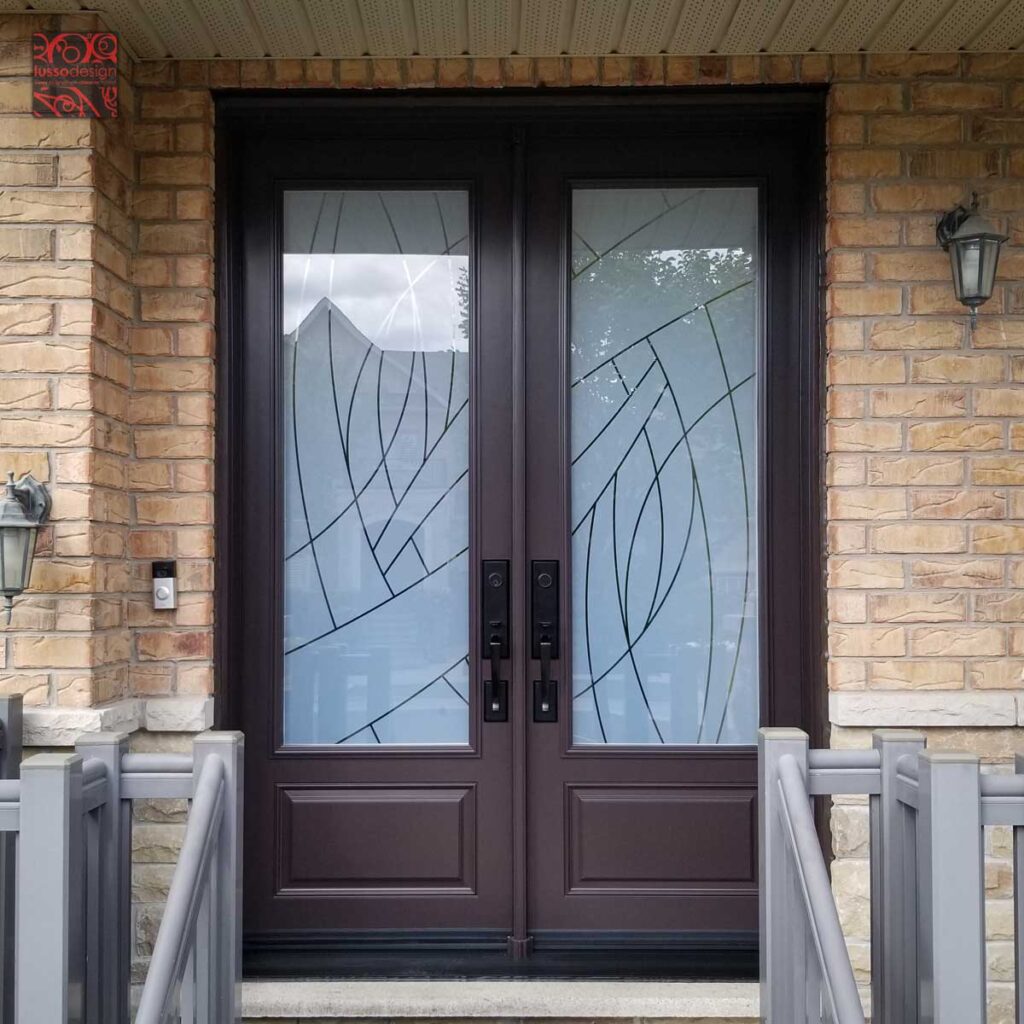
Most of the custom door glass projects I work on involve decorative metalwork, with the occasional beveled glass design mixed in. That’s where my background is, and it’s still one of my favorite ways to create unique front doors.
But every once in a while, a project comes along that gives us an opportunity to try something completely different. This custom double door project was one of those experiments. Instead of using traditional sandblasted glass, we decided to explore a new printing technique that would allow us to create much more intricate decorative patterns with exceptional precision.
And, as usual when experimenting with something new, figuring out how to make it work turned out to be half the fun.
The Limitations of Traditional Sandblasted Glass
When it comes to creating privacy glass with clear decorative patterns, sandblasting has traditionally been one of the most common approaches. The process is relatively simple. You start with a clear piece of glass and cover the areas you want to remain transparent with protective masking material. The exposed surface is then sandblasted, creating a frosted appearance. Once the masking is removed, the protected areas remain clear, forming the decorative design.
It’s a great technique for simple geometric patterns, straight lines, and larger decorative elements. But I’ve always been curious about how far we could push the complexity of those designs. What if we wanted extremely fine lines, intricate curves, or a complicated pattern that needed to be positioned with almost perfect accuracy?
That’s where traditional sandblasting starts becoming more challenging, particularly when the design has to continue across multiple glass inserts.
Experimenting with High-Precision Glass Printing
This project gave us an opportunity to try a completely different approach, thanks to our friends at Digital Fabrication. Instead of sandblasting the glass, we used a specialized high-precision printer to apply the decorative pattern directly onto the glass surface. The idea was to reproduce the appearance of traditional frosted privacy glass while giving ourselves significantly more flexibility with the design.
Of course, getting the printed glass to actually look like sandblasted glass wasn’t quite as straightforward as we expected. We spent some time experimenting with different printing techniques to achieve the right level of opacity. Eventually, we settled on a combination of three printed ink layers that, together, created an appearance remarkably close to conventional sandblasted glass.
That was a pretty exciting development because it meant we could now create highly detailed custom privacy glass patterns without being limited by the practical challenges of traditional masking and sandblasting.
Redesigning the Pattern for Double Doors
The printing process was only one part of the challenge. The decorative pattern itself also required quite a bit of work. The client had found a design in another manufacturer’s catalog that they really liked, and we used it as inspiration for the project.
However, once I started adapting the pattern to the actual dimensions of the double door system, I realized that the lines didn’t connect properly between the two glass inserts. A design that looks great on one piece of glass doesn’t necessarily work when it’s divided across two doors. The proportions, spacing, and direction of the lines all need to be considered.
Rather than simply resizing the original artwork, I ended up redrawing the pattern to create a more natural flow from one door to the other. The goal was to make the design feel like one continuous composition rather than two separate decorative glass inserts. And once everything was properly aligned, the result looked exactly the way we wanted.
How Digital Printing Expands Custom Glass Design
One of the biggest advantages of digitally printed glass is the freedom it gives us when creating custom decorative patterns. With traditional sandblasting, more complicated designs often require significantly more preparation and manual work. Digital printing changes that process.
Once the artwork is prepared, intricate geometric patterns, fine lines, and complex compositions can be reproduced with impressive accuracy. It also allows us to control the placement of individual elements much more precisely. That’s particularly useful for custom front doors, where glass inserts often come in unusual sizes and the artwork needs to be adjusted to match the proportions of the entire entry system.
It’s similar to what happened when laser cutting became widely available in the custom metalwork industry. Suddenly, designs that would have been extremely difficult or practically impossible to manufacture by hand became achievable. And for someone who enjoys creating original door designs, that’s a pretty exciting development.
Learning Through Experimentation
Of course, the production process wasn’t without a few hiccups. Whenever you’re experimenting with a new fabrication method, there are always unexpected challenges. We had to spend time figuring out the printing technique, adjusting the opacity, and making sure the final artwork translated properly onto the glass.
But that’s also one of the things I enjoy most about projects like this. The time spent solving those problems doesn’t benefit just one installation. Once we’ve figured out a new technique, it becomes another option we can use for future custom door projects.
And in this case, we actually found another opportunity to use it fairly quickly.
Final Thoughts
This project is a great example of how advances in fabrication technology continue to expand what’s possible with custom decorative door glass. Just as laser cutting allowed us to create intricate metalwork patterns that would have been nearly impossible to produce by hand, high-precision glass printing gives us a completely new way to approach privacy glass. We’re no longer limited to relatively simple sandblasted patterns or standard catalog designs.
Instead, we can create detailed custom artwork, adjust it to the exact dimensions of the glass, and make sure every element flows properly across the entire entry system. And that’s exactly the kind of creative freedom that makes this work so interesting to me.
As always, it’s all in the details.