

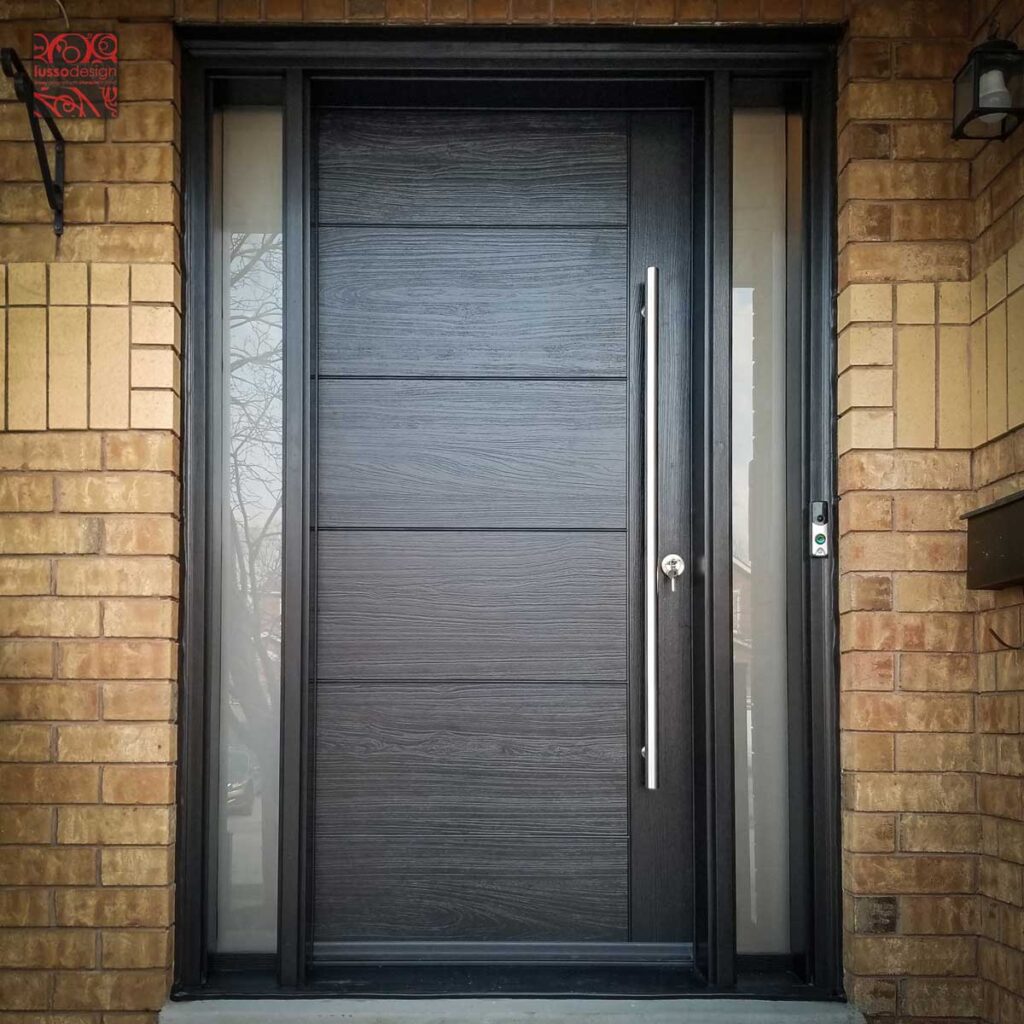
Over the last five to six years, contemporary style doors with linear patterns have really taken off. Clean lines, minimalism, and geometric layouts have become the go-to for modern entryways—and for good reason. They’re versatile, timeless, and work well across a wide range of home styles.
Most of these doors are created in a fairly similar way.
You start with a flush door panel—essentially a flat slab with wood grain texture but no actual paneling or detailing. From there, the design is added using a CNC router (or sometimes even a handheld router), carving lines directly into the surface of the door.
The key detail here is that the wood grain always runs in one direction, regardless of the pattern you carve into it. It looks clean and modern, but if you pay attention, it doesn’t fully replicate how real wood behaves.
How Real Wood Doors Differ
If you were building the same design using a solid wood door, the process would be completely different.
Instead of routing patterns into a flat surface, you’d construct the door out of individual planks or panels, each with its own grain direction. That subtle variation is what gives real wood doors their depth and authenticity.
That’s where this particular project becomes interesting.
Pre-Molded Fiberglass with True Panel Grain
This door is an example of a pre-molded contemporary fiberglass door, where the manufacturer invested in creating a dedicated mold for the design itself—not just engraving it afterward.
What does that mean in practice?
It means the door is manufactured with separate panel sections built into the mold, allowing the wood grain to follow each panel individually—just like it would on a real wood door.
The result is a much more convincing wood-like appearance, while still benefiting from everything fiberglass offers: durability, stability, and low maintenance.
The Trade-Off: Limited Sizes
Of course, there’s always a catch.
Because this design requires a specific mold, the available sizes are limited. This particular model—known as Modern Teak—is only available in:
-
32″, 34″, 36″, and 42″ widths
-
Standard height (no 8-ft option)
In this case, we needed a 36″ standard height door, and the client was already drawn to this exact style, so everything lined up perfectly.
But in many projects, these size limitations can become a constraint, especially when working with oversized or custom openings.
Where Fiberglass Doors Are Heading
What’s really interesting right now is where the industry is going next.
As fiberglass door systems continue to evolve, some manufacturers are starting to experiment with using actual pieces of fiberglass skin to build up more complex, custom panel designs. It’s still early, but the potential is there to move beyond both flat CNC engraving and fixed molds.
And honestly, it’s about time.
Simple linear patterns have been done over and over again. They still look good—but they’re no longer surprising. In 2023, we started pushing into more advanced modern designs, and there’s a lot more coming.
The next few years are going to be interesting.
Final Thoughts
Contemporary doors aren’t going anywhere. But the way we design and manufacture them is changing quickly.
We’re moving from simple surface-level designs to more structural, panel-based approaches that better replicate real materials while keeping the performance benefits of fiberglass.
And if this is where things are now, I’m genuinely curious to see where they’ll be in the next two to five years.